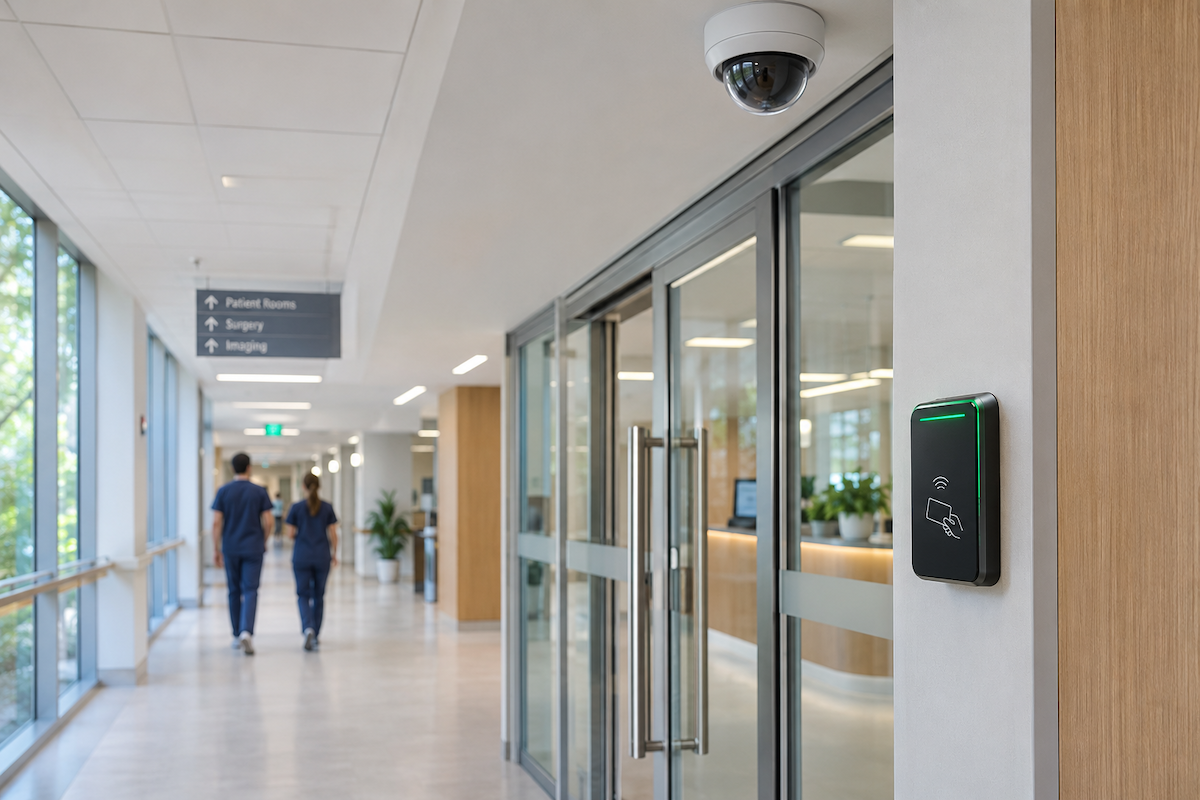
Protect patients, staff, visitors and sensitive areas without slowing down care. Cook Solutions Group designs, installs, integrates and services access control, video surveillance, alarms and analytics for hospitals, clinics and multi-site health systems, with local technicians who keep critical systems running.

Healthcare facilities stay open to the public around the clock while protecting the areas that must stay restricted. Emergency departments, pharmacies, nurseries, behavioral health units, records rooms and loading docks each have different risks and different people who need access. CSG plans the system around how each building operates, who moves through it, and what the security and clinical teams need to see when something happens.
The plan starts with the facility's layout, existing systems, recent incidents and policies, then defines what to keep, integrate, upgrade or phase in.

Monitor high-traffic entries, control after-hours access, and give security staff live video when an incident starts.
Limit entry to authorized staff, record every access event, and pair door activity with video for investigations.
Restrict rooms that hold patient information and network equipment, with audit trails that support HIPAA physical safeguard reviews.
Control movement in and out of secured units and alert staff when a protected door is opened or held.
Use perimeter detection, license plate recognition and analytics to watch parking areas, deliveries and after-hours activity.
Standardize credentials, permissions, camera naming and service processes across hospitals, clinics and medical office buildings.
Once the core systems are in place, CSG can add technologies that improve awareness and reduce manual work.
An upgrade starts with what is already in place. CSG reviews camera models, access-control hardware, alarms, software and network requirements to determine which equipment can remain, which connections are supported, and where upgrades are needed.
For phased projects, CSG works with your facilities, security and IT teams to identify priorities, coordinate installation windows, and test the selected integrations. The plan includes access permissions, operator training, documentation and ongoing service.
Cook Command Center gives approved healthcare teams one place to view supported equipment, open and closed service requests, preventive maintenance, reports and documentation.
CSG brings the core systems onto one coordinated platform so an alarm or access event comes with the video that explains it.
Hospital access control systems use badge or mobile credentials, schedules and role-based permissions to manage staff entry. Intercoms support controlled entry, and access records can be paired with video for incident review.
Hospital video surveillance provides live and recorded views of entrances, emergency departments, parking, corridors and loading areas. Piko brings supported cameras and security events together for monitoring and incident review.
Intrusion, panic and door-forced alarms, plus perimeter detection that identifies threats before they reach the building.
Remote device monitoring, system administration, health checks and reporting from CSG's Network Operations Center.
CSG serves healthcare facilities across 12 western states. Coverage and project fit are confirmed during the assessment.
Further reading: Hospital and healthcare security integrations guide
CSG installs and services access control, video and alarm equipment from these manufacturers, and supports many systems already in place at hospitals and clinics.


Most hospitals rely on access control for staff and restricted areas, video surveillance for entrances and public spaces, intrusion and panic alarms, and perimeter detection for parking and the building exterior. The right plan depends on the facility's layout, risks and policies, which is why CSG starts with an assessment.
Often, yes. CSG reviews equipment models, software versions, network requirements and supported connections to determine what can be kept, integrated, upgraded or phased out. Compatibility is evaluated before a configuration is recommended.
Access control can record credential activity at restricted rooms, while appropriately placed cameras can provide context for incident reviews. Those records help a facility document and review its physical safeguards. Compliance also depends on the facility’s policies, procedures and broader security program.
CSG combines role-based access control, door alarms and video coverage to help restrict entry to authorized staff and give investigators access records and related video for incident review.
Yes. Projects can be phased by floor, department or building, and scheduled around patient care so critical areas stay protected during the work.
Yes. CSG can standardize credentials, permissions, camera naming, documentation and service across hospitals, clinics and medical office buildings in its 12-state service area.
CSG offers preventive maintenance plans, custom service SLAs with local technicians, managed services with remote device monitoring, and service visibility through Cook Command Center.
Bring a list of locations, the main issues you want to address, available equipment details, and any current drawings or service requirements. Include the facilities, security and IT contacts responsible for planning and operating the system.
Hospital access control uses credentials, door hardware and configured permissions to manage who can enter each area and when. CSG plans badge or mobile access, staff schedules and intercoms around the facility. Supported integrations can connect door activity with video and alarm events.
Cost depends on the number of facilities and doors, camera coverage, existing equipment, integration requirements, installation phasing and ongoing support. CSG reviews the facility and current systems to define the scope, priorities and service requirements before recommending a solution.
Share your facility types, locations, current systems, recent concerns and planned projects. CSG will review your security needs and recommend the right next step for assessment, integration, upgrades or ongoing support.