Security gets complicated when the risk is not tied to one doorway or one permanent camera. Maybe your inventory moves around a yard, your job site changes week to week, or your event only exists for a weekend. In those situations, a fixed camera install can be slow to deploy and hard to adapt as conditions shift.
A mobile surveillance vehicle is built for that kind of reality. It gives you camera coverage you can place quickly, move when your risk areas move, and monitor in a way that supports real decisions, not just after-the-fact footage.
This article walks through how mobile surveillance vehicles work, where they fit best, and how AI threat detection with human verification helps turn video into useful, actionable security.
What is a mobile surveillance vehicle?
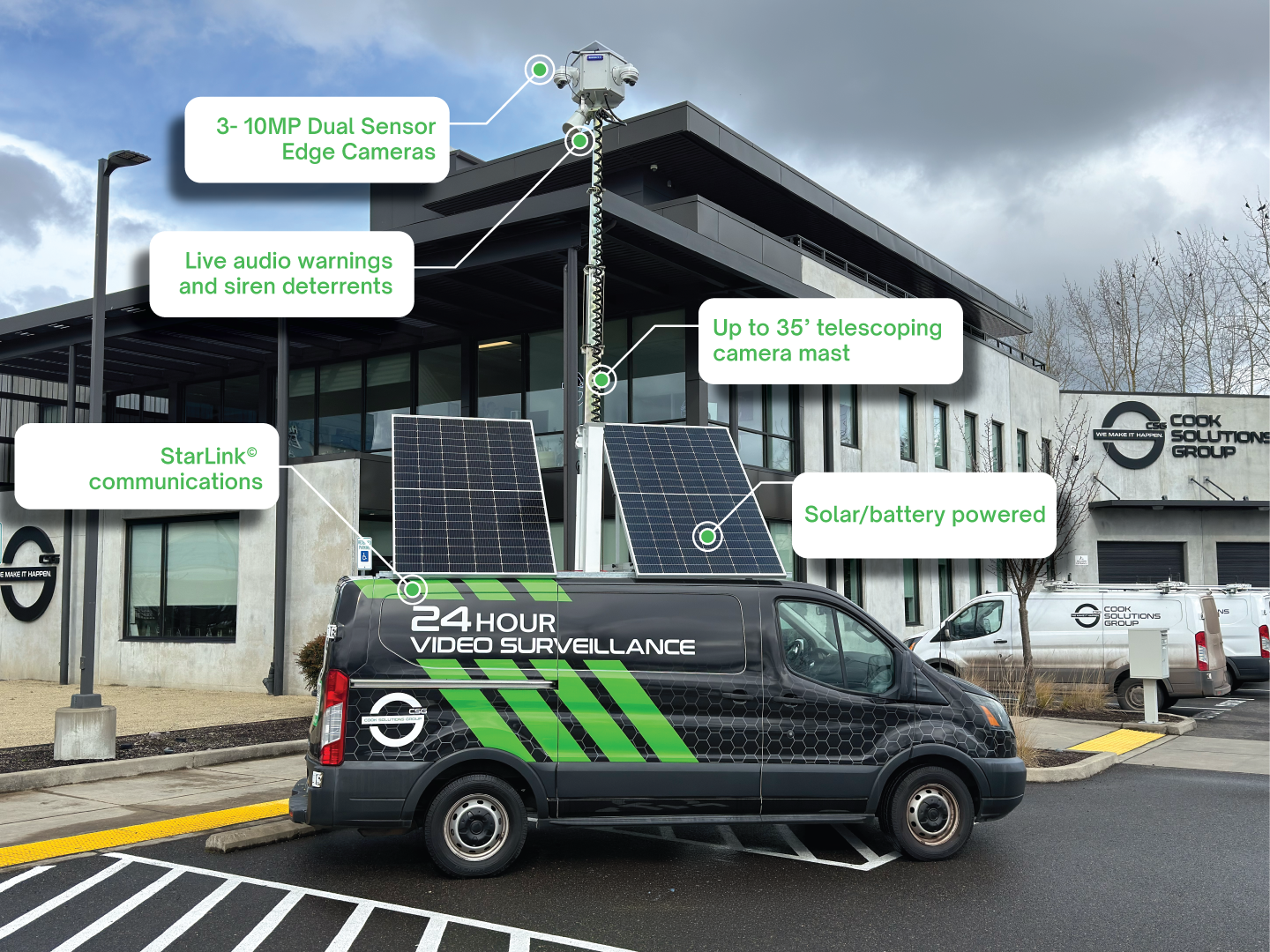
A mobile surveillance vehicle is a self-contained unit that brings video coverage to a location without requiring you to mount cameras on buildings, install poles, or run long cable paths. Think of it as “security coverage on wheels,” designed to be positioned where you need it most.
The big advantage is not just mobility. It is speed and flexibility. When your risk shifts from the front gate to the back lot, or from the storage area to the loading dock, you can adjust coverage without redesigning your entire security system.
When mobile surveillance makes sense
Mobile systems are usually a strong fit when at least one of these is true:
- You need coverage fast and do not want to wait on a permanent install timeline.
- Your environment changes (construction phases, rotating inventory, new access points).
- Your site is large and one fixed camera system would be expensive or incomplete.
- You have a specific problem area (repeat vandalism zone, theft hot spot, after-hours loitering).
- You are operating temporarily (events, seasonal operations, short-term projects).
A good rule of thumb: if you are saying “we just need something there right now” or “the problem keeps moving,” mobile surveillance is worth considering.
Use cases: business, job site, and event
A mobile surveillance vehicle can be positioned to cover:
- Entrances and exits (vehicle and pedestrian)
- Loading zones and delivery lanes
- Parking lot choke points (where vehicles must pass)
- Blind spots created by buildings, fencing, or landscaping
- High-theft targets like catalytic converters, tools, and outdoor inventory
Where AI adds value: AI can focus attention on after-hours behavior patterns that often lead to incidents, like repeated pass-bys, loitering, or entry into restricted zones.
Where human verification adds value: It reduces false alarms from headlights, late-shift employees, cleaning crews, or normal traffic flow.
Mobile surveillance vehicles are often used to monitor:
- Gate lines and common entry paths
- Tool containers and storage areas
- Material stockpiles (wire, copper, lumber, fuel)
- Heavy equipment staging areas
- Temporary offices and access control points
Where AI adds value: AI can prioritize the highest-risk actions, like someone entering a restricted zone after hours or approaching equipment storage repeatedly.
Where human verification adds value: Job sites are noisy environments. Wind, tarps, reflective surfaces, and animals can trigger alerts. Verification keeps the response focused on real issues.
A practical tip for job sites: plan for movement. The best deployments include a weekly review, even if it is only 10 minutes, to confirm the unit still covers the real risk areas.
Mobile surveillance vehicles can support:
- Parking lot monitoring before, during, and after events
- Vendor and back-of-house access points
- Restricted perimeter areas
- Entry and queue zones where disputes can start
- Documentation for incident review, if needed
Where AI adds value: AI can help flag unusual movement into restricted areas, or activity patterns that stand out during low-traffic hours.
Where human verification adds value: Events have a lot of “normal chaos.” Verification helps prevent overreacting to standard event behavior while still catching real issues early.
This planning step is where you get a lot of value. It prevents the common problem of deploying cameras first, then trying to figure out what you wanted them to do after the first incident.
Reducing false alerts: how to keep the system usable
Even smart analytics need tuning. If you want AI alerts to help, not annoy, focus on these fundamentals:
Use zones that match risk
Exclude roads, tree lines, and areas that generate constant movement. Put your detection zones where incidents are likely to start, like gates, loading areas, and storage zones.
Use schedules
Business hours and after-hours should behave differently. A delivery at 2 p.m. is normal. A person behind the building at 2 a.m. is not.
Prioritize alerts
Not every alert deserves the same urgency. A restricted-area entry after hours should rank higher than movement in a low-risk corner of the lot.
Review patterns early
The first few days of alerts tell you what needs adjustment. If the same false trigger repeats, change the zone, adjust sensitivity, or narrow the rule so it matches the environment.
When AI is tuned well and verified by a person, the alert stream becomes something your team can trust.
The role of AI: turning video into meaningful alerts
Traditional cameras record everything, which is both helpful and overwhelming. If nobody is watching, the camera often becomes a tool for learning what happened later.
AI video analytics changes that by scanning the live video feed for activity that matches rules you set, then generating alerts when something looks like a real security concern. Instead of relying on raw motion detection, AI can be configured to recognize and prioritize more relevant patterns.
Depending on the configuration, AI can help identify things like:
- A person entering a restricted zone after hours
- Loitering near entrances, loading docks, equipment, or fenced areas
- Vehicles entering a closed yard or stopping where they should not
- Movement near high-value targets (containers, generators, copper, tools, fuel)
- Activity that is unusual for the time of day, based on schedules
This is where mobile surveillance becomes more than “a camera on a vehicle.” AI helps filter the noise and elevate the moments that deserve attention.
Why human verification matters (and why it is paired with AI)
AI is useful, but it is not perfect. Sites have shadows, headlights, wind-blown materials, animals, and normal activity that can look suspicious on video. If every alert triggers a response, you end up with the most common security failure: alert fatigue.
That is why many modern mobile surveillance programs use human verification of AI alerts.
Here is what that means in practice:
- AI detects activity and generates an alert.
- A trained operator reviews the video quickly to confirm what is happening.
- Only verified events trigger the next step, such as notifying your team or escalating to law enforcement.
This pairing creates a balance:
- AI provides speed and consistency (it does not get tired and it does not miss patterns).
- Humans provide judgment and context (they can tell the difference between a real threat and a harmless situation).
If you want a system people will actually trust and use, human verification is often the difference between “helpful” and “ignored.”
What the AI + human workflow looks like
A simple, effective workflow usually follows this path:
- Detection rules are set (zones, schedules, priority areas).
- AI generates an alert when activity matches those rules.
- A human reviews the clip to verify what is happening.
- Next steps follow your instructions, which might include:
- Document only
- Notify an on-call contact
- Trigger a site-specific escalation plan
- Contact law enforcement when thresholds are met
- Evidence is saved and tagged so it is easy to find later.
This structure is valuable because it turns “security” into a repeatable process. It also improves response quality, because the person responding is not guessing. They have verified details like where the activity is happening, how many people are involved, and what direction they are moving.
What success looks like: practical ways to measure results
Security can feel subjective, so it helps to track a few simple indicators:
- Verified incidents vs false alarms (a direct measure of tuning quality)
- Time from alert to verification (how quickly you know what is happening)
- Time from verification to action (how quickly your plan moves)
- Repeat hot spots (are incidents clustering in the same place?)
- Evidence quality (clear angles, readable identifiers, usable clips)
You do not need perfect data to see improvement. If your team is receiving fewer meaningless alerts, responding faster to verified threats, and dealing with fewer repeat incidents, the system is doing its job.
Privacy and responsible use
Mobile surveillance often covers public-facing spaces like lots, perimeters, or event areas. A responsible program includes clear expectations and simple rules:
- Post signage that monitoring is in use when appropriate.
- Limit footage access to people who need it.
- Set retention policies that match operational and legal requirements.
- Have a process for handling footage requests if they arise.
This helps keep your security plan predictable and easier to manage, especially if multiple teams or locations are involved.








.png)