Quick Summary (1-Minute Scan)
- A Network Operations Center, or NOC, gives financial institutions and commercial organizations a centralized team and system for monitoring security, technology, alarms, video, and operational events.
- The biggest value of a managed NOC is not the room itself. It is the people, processes, escalation paths, documentation, and resilient monitoring environment behind it.
- Most organizations already have enough internal responsibilities. A managed NOC helps reduce the burden on branch staff, facility teams, IT teams, security leaders, operations managers, and executives by giving them a dedicated partner watching for issues and coordinating response.
- A strong NOC partnership supports faster verification, better communication, stronger documentation, and more consistent follow-through when something happens.
- For banks, credit unions, commercial facilities, and multi-site organizations, the question is not simply, “Who is watching?” It is, “Who is watching, what can they see, how fast can they act, and how well is the response documented?”
Financial institutions and commercial organizations operate in environments where small problems can become serious quickly. A failed camera, a door forced open after hours, a network interruption, an ATM alarm, or a branch security event may seem isolated at first. But without the right visibility and response process, those events can create operational risk, customer disruption, security exposure, and unnecessary stress for internal teams.
That is where a managed NOC becomes valuable.
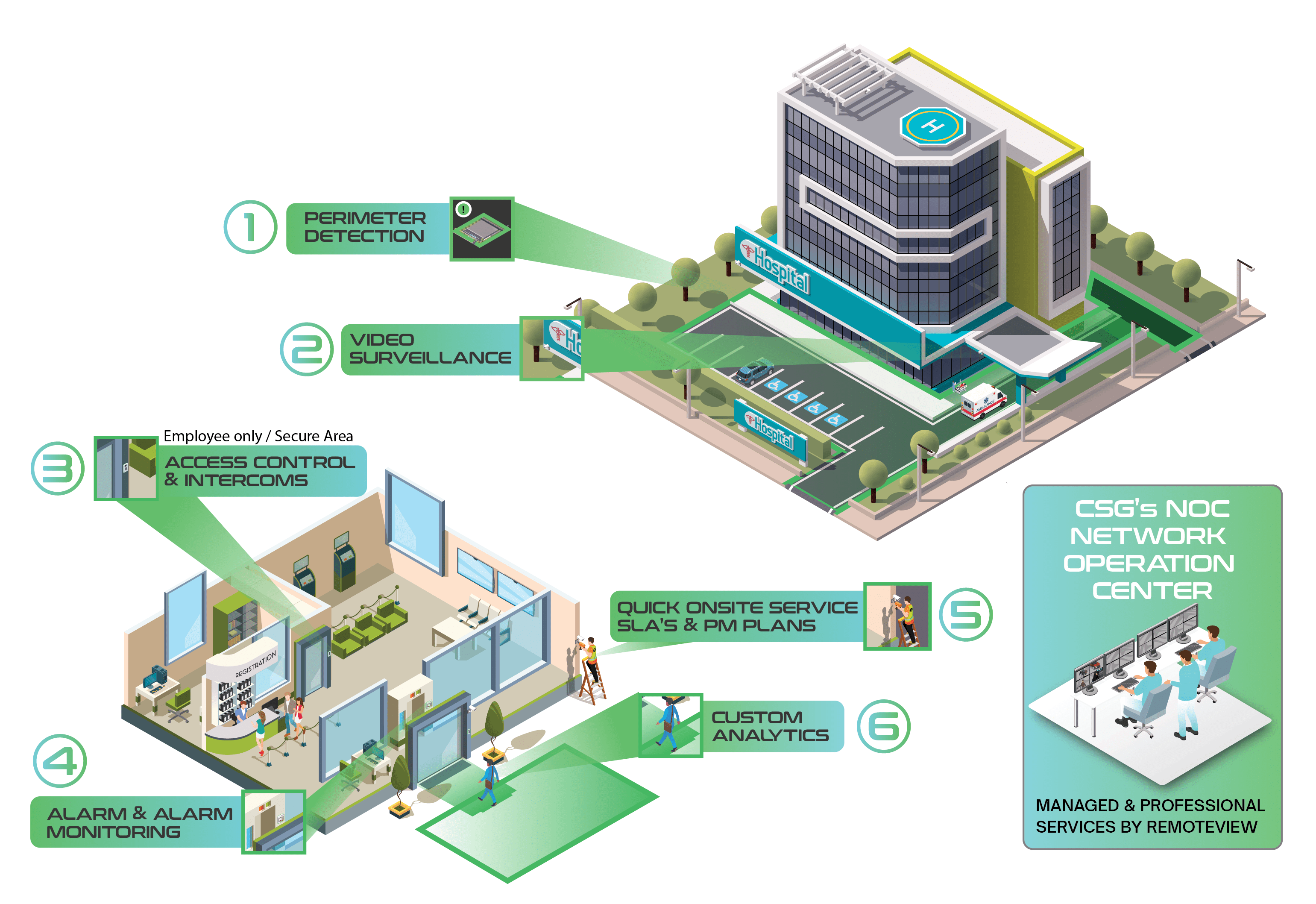
A NOC is not just a room with screens. It is a centralized monitoring function built around trained operators, connected systems, documented workflows, escalation paths, and continuous visibility. When an organization partners with a company that already has a NOC system in place, it gains access to a mature monitoring environment without having to carry the full staffing, technology, process, and oversight burden internally.
This article explains why a managed NOC partnership matters, what problems it helps solve, and how it supports stronger security and operations across branches, ATMs, ITMs, commercial facilities, campuses, offices, warehouses, and critical systems.
A NOC Is a Response Function, Not Just a Monitoring Function
It is easy to think of a NOC as a place where people watch cameras or alarms. That is only part of the picture.
The real purpose of a NOC is to help turn signals into action. A signal could be a video event, access control alert, equipment issue, alarm notification, network condition, or service-impacting problem. The NOC’s job is to help determine what is happening, how serious it is, who needs to know, and what response should happen next.
That response-focused role is what separates a true managed NOC from passive monitoring.
In a strong NOC environment, operators are not simply waiting for something to appear on a screen. They are following defined workflows. They know what needs to be verified, what information should be documented, when to escalate, and who should be contacted. That structure helps reduce confusion during high-pressure moments.
For financial institutions and commercial organizations, this matters because branches, facilities, ATMs, offices, warehouses, campuses, and security systems do not operate in isolation. A single incident may involve security, IT, facilities, vendor support, site leadership, operations teams, and law enforcement. A managed NOC helps coordinate those moving parts so the response is more consistent and less dependent on whoever happens to notice the issue first.
Why Monitoring Gets Harder as Systems Multiply
Financial institutions and commercial organizations have more connected systems than ever. A single organization may depend on video surveillance, access control, intrusion alarms, ATM and ITM monitoring, environmental sensors, network equipment, intercoms, drive-up systems, cash automation, facility systems, and branch or site technology.
Each system may generate its own alerts, logs, dashboards, or service notifications. Without a centralized monitoring partner, those signals can become scattered across different vendors, platforms, inboxes, and departments.
That creates several problems.
- Important alerts may be missed because no one owns the full picture.
- Branch or site employees may become responsible for technical or security follow-up that distracts from serving customers, tenants, employees, or visitors.
- IT teams may get pulled into issues that are not purely IT problems.
- Security teams may lack the time or staffing to watch every event in real time.
- Executives may only hear about problems after they have already caused disruption.
A managed NOC helps bring order to that complexity. It creates a central point of visibility and accountability so the organization is not relying on fragmented notifications or informal communication.
The Value of a Partner That Already Has a NOC System
Partnering with a company that already operates a NOC gives an organization access to an established monitoring structure. That structure typically includes trained staff, documented procedures, connected technology, redundant systems, escalation protocols, reporting practices, and experience handling recurring event types.
The value is not just that another company is watching. The value is that the partner has already organized the people and systems needed to watch effectively.
A strong managed NOC partner can help answer practical questions such as:
- What happened?
- When did it happen?
- Which location or system was affected?
- Was the event verified?
- Who was contacted?
- What action was taken?
- What should be reviewed afterward?
Those answers are critical during incidents, but they are also useful for long-term improvement. Over time, NOC data can help identify repeat issues, weak points, vendor problems, training gaps, and locations that need more attention.
1) Around-the-Clock Visibility
Many security and operational issues do not happen during convenient business hours. Doors can be forced after closing. Equipment can fail overnight. ATM alarms can trigger on weekends. Network problems can affect visibility before staff arrive in the morning.
A managed NOC provides a dedicated monitoring layer that is not limited by branch hours or internal staffing schedules. That continuous visibility helps organizations respond faster and avoid discovering problems too late.
This does not mean every event requires an emergency response. It means events can be seen, triaged, and handled according to their level of urgency. Some events may require immediate escalation. Others may be logged for review, assigned for service, or watched for patterns.
The important point is that there is a process in place when something occurs.
2) Faster Verification and Escalation
Speed matters, but so does accuracy. Responding too slowly creates risk. Responding to every alert as if it is a major emergency creates noise and fatigue.
A managed NOC helps with both sides of that problem by verifying events before they are escalated whenever possible. Operators may check video, review related alerts, confirm access activity, or follow a defined call tree before pushing an issue to the next level.
That verification step helps reduce false alarms and makes escalations more useful. Instead of receiving a vague alert, the organization receives clearer information about what is happening and what action may be needed.
For example, the difference between “door alarm” and “rear entry door forced open at 10:42 p.m., no authorized badge activity, video shows movement near the entrance” is significant. The second message gives the receiving team a better basis for action.
3) Better Documentation and Accountability
In security and operations, documentation is often as important as detection. After an event, leaders need to know what happened, when it happened, who responded, and whether the process worked.
A managed NOC supports that accountability by creating a more consistent record of activity. Depending on the event and system, documentation may include timestamps, video references, access control events, operator notes, escalation attempts, service tickets, and follow-up actions.
This documentation helps in several ways.
- It supports internal review.
- It helps leadership understand what occurred.
- It gives security and operations teams a clearer event history.
- It helps vendors and technicians troubleshoot recurring problems.
- It reduces reliance on memory or informal messages.
Without this kind of documentation, organizations may know that something happened but struggle to prove the timeline or evaluate the response.
4) Better Use of Video, Alarms, and Access Control
Financial institutions and commercial organizations invest heavily in security technology, but technology is only as useful as the process around it. Cameras, alarms, and access control systems produce valuable information, but that information needs to be watched, interpreted, connected, and acted on.
A managed NOC helps turn those systems into an active operational resource.
- Video can help verify whether an alarm is real, identify who was present, and provide context before someone is dispatched.
- Access control can show whether a door was opened with an authorized credential, held open, forced, or accessed outside normal patterns.
- Alarm activity can be reviewed alongside video and access events to create a more complete picture.
When these systems are monitored together, the organization gets better situational awareness than it would from isolated alerts.
5) Resilience When Something Fails
A strong NOC partnership also matters because monitoring systems need to keep working through disruption. Outages, hardware failures, network issues, communication problems, and platform interruptions can all affect visibility.
A managed NOC should be built around resilience. That may include redundant power, backup communication methods, failover planning, monitoring system health checks, documented degraded-operation procedures, and regular testing.
The goal is not to pretend failures will never happen. The goal is to make sure the monitoring function does not fall apart when they do.
For financial institutions and commercial organizations, resilience is especially important because many systems are connected to trust, safety, customer experience, employee access, and operational continuity. When something goes wrong, the institution needs confidence that someone can still see the issue, communicate clearly, and help coordinate the next step.
6) Less Operational Drag on Internal Teams
One of the most practical benefits of a managed NOC is reduced internal burden.
Branch teams should not have to become alarm-monitoring teams. IT teams should not have to manually chase every security event. Security leaders should not have to depend on fragmented information from multiple platforms and vendors. Executives should not have to wonder whether important issues are being seen and handled.
A managed NOC gives the organization a dedicated partner for monitoring and response coordination. That does not remove internal responsibility, but it does make that responsibility easier to manage.
Instead of asking internal teams to watch everything all the time, the organization can rely on a structured monitoring partner and focus internal attention where it is most needed: decision-making, customer service, policy, risk management, and strategic operations.
What a Strong NOC Partnership Should Feel Like
A strong managed NOC partnership should make operations feel clearer, not more complicated.
The organization should know what is being monitored, how events are prioritized, who gets contacted, how information is documented, and what happens after an event is closed. There should be clear expectations around communication, escalation, service coordination, and review.
The best partnerships are not built around vague promises of “watching everything.” They are built around practical workflows that answer important operational questions:
- What events require immediate action?
- What events should be documented for review?
- Who should be contacted for each type of issue?
- What information should be included in an escalation?
- How are recurring problems identified?
- How does the organization review NOC performance over time?
These questions help turn monitoring into a reliable operating system instead of a loose collection of alerts.
Where a Managed NOC Fits in a Broader Security Strategy
A managed NOC is not a replacement for good security planning. It works best as part of a broader strategy that includes physical security, cybersecurity coordination, access control policies, video standards, alarm procedures, vendor management, employee training, and executive oversight.
The NOC connects many of those pieces by giving the organization a place where events are seen, verified, documented, and escalated. It helps bridge the gap between technology and action.
That is why the value of a NOC is not limited to emergencies. It can also support day-to-day operational consistency, service awareness, branch support, vendor coordination, and better long-term decision-making.
Final Takeaway
Financial institutions and commercial organizations do not just need security systems. They need a dependable way to monitor those systems, interpret what they are saying, and coordinate the right response when something happens.
A managed NOC provides that structure. It gives the organization a partner focused on visibility, verification, escalation, documentation, and resilience. That helps reduce internal strain, improve response consistency, and make security operations easier to manage across locations and systems.
The most important question is not whether a NOC has screens, technology, or alerts. The real question is whether the NOC helps the organization act faster, communicate better, document clearly, and stay operational when pressure is high.